Order Clupeiformes Family Engraulidae(Anchovies)
Moustached thryssa
Thryssa mystax(Bloch & Schneider, 1801) Max length/20.5 cm TL
Korean name/buk-myeol(북멸)
Chinedse name/中颌棱鳀
Dorsal spines (total): 0; Dorsal soft rays (total): 11-12; Anal spines: 0; Anal soft rays: 29 - 37.
Distribution; Indo-West Pacific/Mozambique, Red Sea, coasts around India, Myanmar, Indonesia, Papua New Guinea, Arafura sea, Philippines, Hainan Ialand of China, Taiwan, Shanghai. It is likely to appear on the southwest coast of the Korean Peninsula.
General;
※ [Issue]. It is a species that frequently causes confusion in the process of identification by experts around the world, and the existing research is often reversed. According to a paper published in 1996(Changho Yun, Iksu Kim), the scientific name of “Thryssa mystax”, a species known in Korea as Buk-myeol(North anchovy), was found to be “Thryssa adelae”. Therefore, the fish called Thryssa mystax became a non-distributed species in Korea, and the newly identified “Thryssa adelae” was named “Pul-ban-daeng-i” as Korean name. However, on a fish list introduction site(Fish Nara), data from May 2021, both Thryssa mystax and Thryssa adelae are listed on the list of Korean anchovy fish as valid name, and Thryssa mystax is noted as a new Korean species. Although this is not a thesis, it is a site worth referring to when it comes to introducing fish lists. After the 1996 paper, it is inferred that Thryssa mystax was discovered again off the coast of Korea(I do not have the relevant materials).
==========
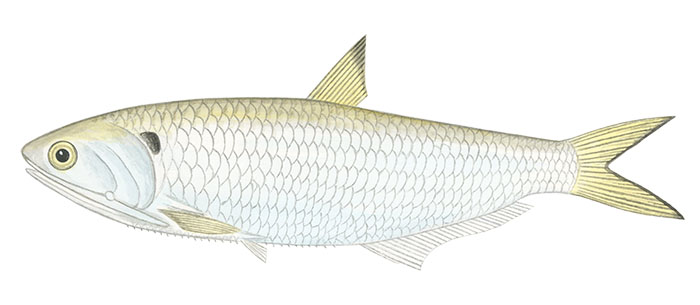
Belly with 24 to 32 keeled scutes from isthmus to anus. Tip of snout on a level with eye center. Maxilla long, reaching to or almost to base of first pectoral fin ray. Because the upper jaw bone is very long, the English name is Moustached anchovy.First supra-maxilla oval, minute. Lower gill rakers with serrae on the inner edge even and not clumped. Body is silver, darker dorsally. Caudal and pectoral fins are yellowish, pelvic and anal fins white. With cycloid scales. A dark blotch behind upper part of gill opening, which can easily identify the species from other Thryssa No spine rays on dorsal and anal fins. absent on fins. Found in coastal pelagic waters and They usually form schools near the coast or at the river mouth estuaries. Juveniles and adults may penetrate the upper reaches where mixohaline-mesohaline conditions prevail. Eggs and larvae are found in the lower reaches of the mangroves. A schooling species found mostly inshore. Feed on planktonic organisms in coastal waters. Juveniles in mangroves feed on larvae of shrimps and fish. Migrating within oceans typically between spawning and different feeding areas, as tunas do. Migrations should be cyclical and predictable and cover more than 100 km.
|

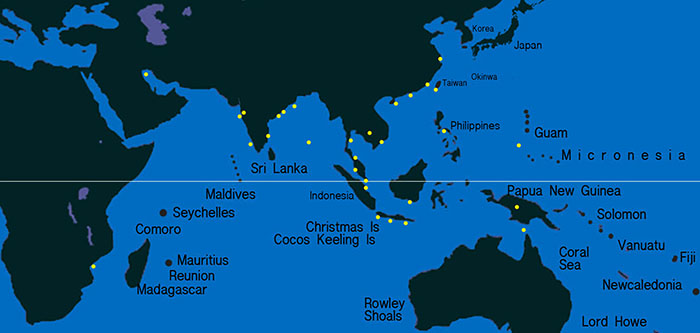 북멸의 분포도. 분포 해역 정보의 출처는 세계생물다양성정보기구(GBIF/2022년)이며 논쟁점은 한국 해역이 제외되어 있다는 것이다. Distribution map of Moustached thryssa(Thryssa mystax). The specific distribution points are data from the Global Biodiversity Information Facility(GBIF/as of May, 2022). The issue is that Korean waters are excluded. Derived work by Kim in young(fishillust.com)
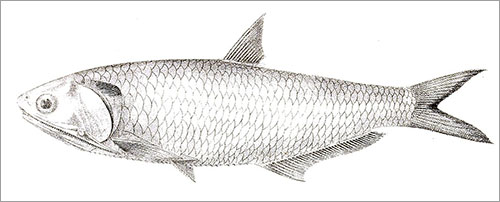 북멸 묘사도. 위턱 뼈가 매우 길어서 영명으로 콧수염 멸(Moustached thryssa)이라고 부른다. Illustration of Moustached thryssa(Thryssa mystax). Date/1878. Author/C. Achilles
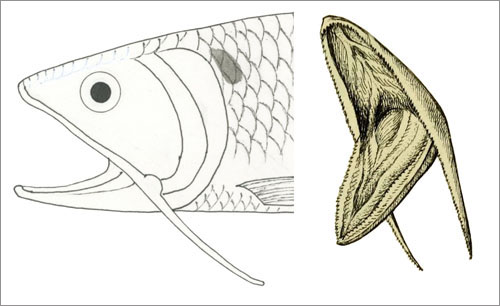 북멸이나 풀반댕이가 입을 벌렸을 때 위턱의 움직임. 위턱의 뒤 끝이 아가미뚜껑을 훨씬 넘어가는 입이 벌어지면 위턱 후단이 몸 밖으로 벗어난다. The movement of upper jaw when Thryssa adelae and Thryssa mystax open their mouth. The posterior part of upper jaw comes off the body. Left/Author; fishillust.com. Right/Bloch, et al.1801
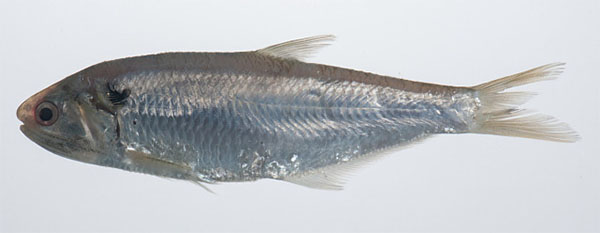 북멸 Moustached thryssa(Thryssa mystax). Photographed during Philippines 2014 expedition. Author/Williams, Jeffrey T.(Smithsonian Institution).
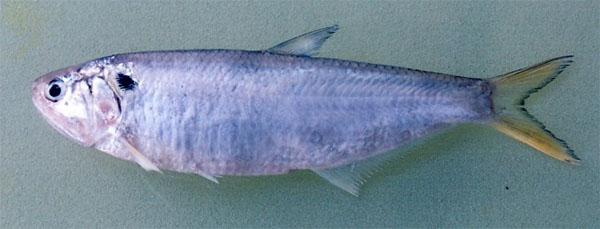 북멸 Moustached thryssa(Thryssa mystax). Author/BEDO(Thailand).




 검색
