
사이트 로그인
사이트 로그인
|
분류계통/경골상강→조기강→연어목(Order Salmoniformes; salmons)→연어과(Family Salmonidae; Salmonids)→살기(Yalu grayling; Thymallus articus yaluensis) Copyright by Kim In Young. 김인영 그림
|

|
| 살기 기본 모습. Lateral view of Yalu grayling(Thymallus articus yaluensis) |
[육봉형 담수어] 분포; 아시아/압록강 상류에 분포. 한국 고유종. 살기는 등지느러미가 아주 큰 것이 특징이다. 큰 부채모양이며 기저부가 길다. 수컷 성어의 등지느러미 더욱 크며 아래로 내리면 기름지느러미에 닿는다. 그러나 암컷은 이보다 짧다. 배지느러미도 큰 편이며 수컷 성어의 경우 뒷지느러미에 닿는다. 암컷은 이보다 짧다. 기름지느러미가 있다. 꼬리지느러미의 후단은 안으로 비교적 깊이 패였다. 꼬리지느러미의 하엽은 상엽보다 더 길 수도 있다. 머리는 작고 눈은 머리 앞쪽으로 치우쳐있다. 주둥이는 매우 짧고 입이 작으며 위턱의 뒤는 눈의 가운데에 이른다. 체고가 높은 편이다. 양턱과 서골, 구개골의 앞쪽에도 이빨이 있다. 비늘은 비교적 큰 편이며 일반적인 연어과 어종의 측선상 비늘 숫자가 200개 이상인데 비해 100개 이내이다. 측선을 완전하고 직선이다. 살기는 색상이 매우 아름다우며 여러 가지로 나타난다. 등쪽은 약간 어두운 황록색이며 검은 자주색이거나 흑청색 내지 청회색일 수도 있다. 체측면은 회색이며 어두운 청색일 수도 있다. 그러면서 보는 각도에 따라 옅은 핑크 빛이 감돈다. 배쪽은 회색 내지 백색이다. 체측에 소수의 검정 점들이 흩어져 있는데 어릴수록 수가 많다. 가슴지느러미와 배지느러미 사이 복부에 몸을 따라 수평으로 놓인 어두운 줄이 한 개 있다. 등지느러미는 검으며 가장자리가 좁게 자주색이며 지느러미 바탕에는 적색 내지 오렌지색 또는 자주색 내지 녹색의 점들이 여러 개의 열을 지어 있다. 배지느러미는 검으며 불규칙한 오렌지 옐로우 색의 줄들이 대각선 방향으로 놓여있다. 꼬리지느러미는 검으며 뒤 가장자리가 적색이다. 기름지느러미, 뒷지느러미 가슴지느러미도 모두 검다. 중,대형 강과 호수에 서식한다. 산란기에는 바위가 많은 상류 산간 계곡으로 올라간다. 많지 않은 수로 무리를 짓는다. 어린 것들은 동물플랑크톤을 먹으며 더 자라면서는 점차적으로 곤충 새끼들을 먹는다. 성어는 수면의 곤충을 주로 먹으며 물고기, 물고기 알, 나그네쥐, 갑각류 플랑크톤도 먹는다. 산란기는 5~6월로 추정되며 유속이 빠른 산간 계곡 하천의 돌과 자갈이 많은 바닥에서 산란한다. 산란기 성어들은 강이나 호수에서 지류를 찾아 상류로 올라간다. 수컷은 자리를 확보하고 암컷에게 등지느러미를 펼쳐 보이며 구애를 한다. 수컷은 암컷 곁으로 가서 큰 지느러미를 암컷의 몸 위로 구부린다. 그 다음 두 마리는 몸을 떨면서 알과 정액을 쏟는다. 둥지를 먼저 만들지 않지만 방정할 때 꼬리를 흔든 것이 어느 정도 바닥이 파지게 한다. 암컷은 한 번만 산란할 수도 있고 자리를 옮겨서 몇 차례 더 산란할 수도 있다. 산란이 끝난 성어들은 수온이 찬 더 상류로 올라가 여름을 나며 대개 9월 중순이면 하류 깊은 수심으로 이동한다. 압록강 상류에 분포한다. 북한에서는 산란지인 양강도 김형직군 연하리 남사강의 살기 알쓸이터(북한 천연기념물 제 371호)를 천연기념물로 보호하고 있다. |
※아래에 소개하는 이미지 7개는 압록강에 사는 살기가 아니며 북극살기(Arctic grayling /Thymallus arcticus)의 것이다. 압록강 살기는 북극살기의 여러 아종 중 하나이며 외관의 차이가 비슷하다고 볼 수 있다. 살기의 제대로 된 이미지가 발견되지 않아 북극살기 이미지를 소개한다. |
 북극살기. Arctic grayling(Thymallus arcticus arcticus). Date/1907. Author/A. Hoen and Co. |
 북극살기. Arctic grayling(Thymallus arcticus arcticus). Author/CAFS |
 북극살기. Arctic grayling(Thymallus arcticus arcticus). Date/1886. Author/L. M. Turne |
[Land locked freshwater fish] Distribution; North east Asia/Endemic to Yalu river in North Korea. Grow to a maximum recorded length of 76 cm. Yalu grayling(Thymallus articus yaluensis) is a subspecies that landlocked and indigenized in Yalu river of North Korea. Grow to 30.0 cm TL. Some authors classify as separate species; “Thymallus yaluensis”. Yalu grayling is distinguished by its greatly enlarged fan like dorsal fin. Dorsal greatly enlarged in adults(especially males), reaching adipose fin when depressed, but is shorter in females; pelvic fins rather long, reach anal fin in adult males, but not in females; lower lobe of caudal often longer than upper. Caudal fin relatively deeply emarginated. Has an adipose fin. Body depth relatively deep. Head small, eye located anterior head. Snout very short and mouth small, which has fine teeth on both jaws and with teeth on vomer and palatine bone. Upper jaw reaches below the middle of eye. Scales relatively larger than other salmonids. Lateral line completed and straight. A strikingly colored fish, the dorsal surface is dark greem, or blue black to blue gray, the sides gray to dark blue with pinkish iridescence, the ventral surface gray to white. Scattered dark spots on sides, these being more numerous on the young; a dark longitudinal stripe along lower sides between pectoral and pelvic fins; dorsal fin dark with narrow purple edge(rows of reddish to orange or purple to green spots on body of fin); caudal fin dark with purple margin; pelvic fins dark with irregular diagonal orange-yellow stripes; adipose, anal, and pectorals dusky to dark. Inhabits clear, cold, medium to large rivers and lakes. Enters rocky creeks to spawn. Forms schools in moderate numbers. Young feed on zooplankton with a gradual shift to immature insects; adults feed mainly on surface insects but also take in fishes, fish eggs, lemmings, and planktonic crustaceans. Spawn in May to June. Spawns in montane streams with heavy current on shallows with rock-gravel bottom. Spawning adults move into tributaries and males establish territories. At spawning, the male follows a female, courting her with displays of his dorsal fin. He then drifts over beside her and curves his extended dorsal fin over the female. The pair vibrates and release eggs and milt. No redd is constructed, but the vibrations of the tails during the spawning act stirs up the substrate and produce a slight depression. A female may spawn only once, or several times in different areas. After spawning, adults establish summer territories in pools generally farther upstream from the spawning site, majority moving downstream in mid-September. The spawning place in Yalu river is designated as natural monument of North Korea. |
 북극살기. Arctic grayling(Thymallus arcticus arcticus). An Arctic Grayling in Yellowstone Park Date/2000. Author/National Park Service |
 북극살기. Arctic grayling(Thymallus arcticus arcticus). 북극살기는 미국 모타나주의 보호를 받고 있는 주 물고기이다. Arctic grayling in Montana are a State Species of Special Concern. Author/USFWS Mountain-Prairie |
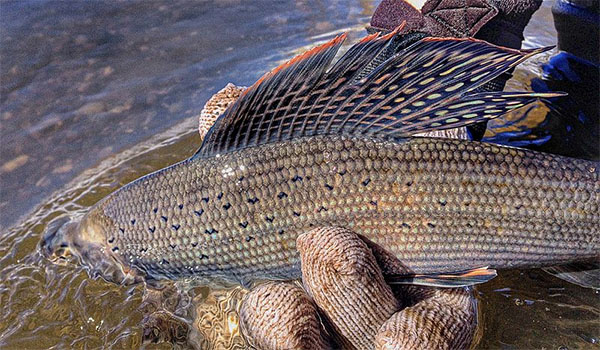 북극살기의 수컷. Arctic grayling(Thymallus arcticus arcticus). A male Arctic grayling(Thymallus arcticus) trapped on Red Rock Creek in Montana in the United States. This male shows the iridiscent, colored dorsal fin of this species. Date/2014. Author/U.S. Fish and Wildlife Service |
 북극살기 유어. Juvenile Arctic grayling(Thymallus arcticus arcticus). Arctic Grayling from Grebe Lake, Yellowstone National Park, 2009. Author/Tim Angeli |
 북극살기. Arctic grayling(Thymallus arcticus arcticus). photographed under water. Clearwater Creek Alaska. Author/Aksmith |


|
| Copyright ⓒ FISHILLUST.COM All rights reserved. All contents can not be used without permission of the copyright holder. |


 검색
