
사이트 로그인
사이트 로그인
분류계통/경골상강→조기강→동갈치목→동갈치과→항알치 Copyright by Kim In Young. 김인영 그림
|
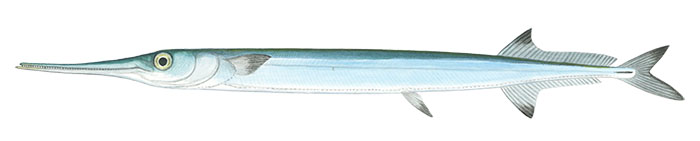 |
| 항알치 기본 모습. Lateral view of Keel-jawed needle fish(Tylosurus melanotus) |
|
Copyright by Kim In Young. 김인영 그림
|
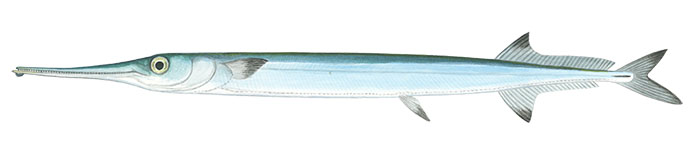 |
| 항알치 기본 모습. Lateral view of Keel-jawed needle fish(Tylosurus melanotus) |
동갈치목 동갈치과 분포; 인도-태평양/한국의 남해, 일본 중부 이남, 타이완, 필리핀, 팔라우, 인도네시아 발리 섬, 코코스 제도, 몰디브, 아프리카 모잠비크, 동중부태평양의 하와이 제도, 레비야히헤도 제도(Revillagigedo/멕시코령), 클리퍼튼 섬(Clipperton/프랑스령), 바하캘리포니아, 코르테즈해. 몸이 길고 거의 원통형이며 단면은 타원형이다 미병부(꼬리자루)는 측편되었다. 양턱은 매우 길고 가는 새 부리처럼 생겼고 길고 날카로운 이빨들이 박혀있다. 양턱의 길이는 대략 동일하며 체장의 18%-20%이다. 아래턱 앞 끝에 도끼 모양의 돌기(keel/용골)가 뚜렷하게 있는 경우가 있고 없는 경우도 있다(논쟁 중인 사안). 어류학계에서는 항알치 종에 대해 논란이 있다. 일부는 항알치가 독립 종이라고 믿고 다른 일부는 Pacific Needlefish(Tylosurus pacificus)의 변종이라고 믿고 있다. 눈은 크고 타원형이며 머리 측면 위쪽으로 가깝게 붙어 있다. 양 눈 사이는 넓으며 약간 안으로 패였고 너비는 눈 지름보다 크다. 콧구멍은 크고 삼각형이며 눈 앞 이마에 위치한다. 입은 크고 납작하다. 아가미 구멍이 넓다. 새조골 막은 협부와 접합되어 있지 않다. 몸은 작은 원형비늘로 덮여 있으며 배열은 매우 불규칙하다. 머리에는 전새개골과 이마에만 비늘이 있고 나머지 부분에는 없다. 측선은 복부의 외곽선에 가깝게 지나가며 꼬리지느러미 기부까지 연장되어 있고 꼬리자루 부분에서는 몸의 중심축으로 올라가 있다. 아가미 갈퀴는 없다. 항문은 뒷지느러미 앞에 있다. 등지느러미와 뒷지느러미는 등의 먼 뒤쪽에 위치하고 서로 대칭적 마주보며 모두 앞 부분이 높다. 등지느러미가 뒤로 가면서 곡선을 그리며 높이가 뚜렷이 높은 모습이 설명된 자료가 있는데 아마 어릴 때나 미성어(subadult) 때의 모습이 아닐까 짐작된다. 가슴지느러미는 짧고 몸 측면 위쪽에 위치해 있다. 배지느러미도 짧으며 눈 중앙에서부터 꼬리지느러미 사이의 중간에 위치한다. 꼬리지느러미는 안으로 깊게 패였고 하엽이 상엽보다 훨씬 길다. 미병부에는 수평 방향의 튀어나온 용골이 있고 이 부분은 색이 검다. 등은 암청색이며 측면은 은색이며 복부는 백색이다, 신선한 상태에서는 등 중심선에 가는 암녹색 줄이 있다. 옆구리에 전체에 걸쳐 연한 청색 줄이 하나가 있다. 등지느러미와 뒷지느러미의 앞 부분, 가스지느러미의 뒤쪽 반 부분, 및 꼬리지느러미의 후연과 상엽은 연한 흑색이다. 체측에 수평으로 놓이는 띠무늬 없다. 유어는 등지느러미 후단부에 검은 색의 확장부가 있으며 정상하면서 없어진다. 외해와 연안에서 발견되며 이따금 해변 가깝게 나타난다. 보통 9m 수심층 공간에서 발견된다. 항알치는 난생이며 알은 점작성 실을 달고 있어서 물체에 들러붙는다. 먹성이 왕성하며 주로 작은 물고기를 먹으며 특히 청어를 즐겨먹는다. 식용어이며 어획량은 많지 않아서 상업적 가치는 약하다. 생선으로 팔리며 맛이 좋은 것으로 알려져 있다. 멕시코에서는 항알치가 드물게 잡히는데 가시가 많아서 식용으로 사용하지 않으며 잡히면 다시 놓아주거나 낚시 미끼로 사용한다. 항알치는 연구가 부족하여 알려진 정보가 부족하다. 한국명 항알치의 유래나 어원을 알 수 없음. |
Order Beloniformes Family Belonidae(Needlefishes) Distribution; Indo-Pacific/South Sea of Korea, South of Central Japan, Taiwan(common), Philippines, Palau, Bali Island, Cocos Islands, Maldives, Mozambique in Africa, East Central Pacific/Hawaiian Islands, Revillagigedo Islands(Mexican Territory) and Clipperton(French territory). Body elongate, almost cylindrical, and the cross section is oval. The rear part of the caudal peduncle is compressed. The upper and lower jaws greatly elongate into a slender beak and studded with long pointed teeth. Both Jaws approximately equal in length(18% to 20% of standard length). A conspicuous ax-like appendage sometimes present at tip of lower jaw(issue in dispute). There is some controversy about this species in the scientific fish community, with some believing that Keeljaw Needlefish is a standalone species and others believing that it is a variation of the Pacific Needlefish (Tylosurus pacificus). The eyes are large, oval in shape, and set high laterally. Interocular interval wide, slightly concave, larger than eye diameter. The nostrils are large and triangular in shape, located on the side of the forehead in front of the eyes. The mouth is large and flat. Gill openings wide. Gill membrane not connected to isthmus. The body is covered with small round scales, the arrangement is very irregular. The head is covered with scales only on preoperculum and forehead the rest part naked. Lateral line runs longitudinally along close to the ventral margin, reaches the base of the caudal fin, and rises toward the center of the body at the caudal peduncle. Gill rakers absent. The anus is located in front of the anal fin. The dorsal fin and anal fin located far behind back, and face each other. The anterior rays of both fins are extended high. The dorsal fin lowers in height as it goes backwards, then rises again in a curve shape. Descriptions that the posterior part of the dorsal fin is considerably high, though lower than the anterior part, are probably the appearance of childhood or subadults. The pectoral fin short, located higher side. The pelvic fin is also short, positioned equidistant from the middle of the eye and the base of the caudal fin. Caudal fin deeply forked, lower lobe much longer than upper. A distinct black lateral keel on caudal peduncle; The caudal peduncle has side bulges(lateral keel). Dark blue upper body, silvery sides, and a white belly, when fresh, with a narrow dark green longitudinal band on the dorsal midline. They also have a light blue stripe along their flanks. The front of the dorsal and anal fins, the rear half of the pectoral fin, and the trailing edge and upper lobe of the caudal fin are light black. Body side without transverse band. Juveniles with elevated black lobe in posterior part of dorsal fin which is lost with growth. Inhabit offshore and coastal waters, occasionally close to the shore. found in the first 9 m(30 feet) of the water column. Oviparous. Eggs may be found attached to objects in the water by tendrils on the egg's surface. It is ferocious and feeds mainly on small fish, especially herring. Edible fish, but the output is not much, and it has less economic value. It is generally used for frying. Marketed mostly fresh. The flesh is of good quality. Although uncommon in Mexican waters it is viewed by locals as a pest with “too many bones” to be utilized for food. They are either a “catch and release” or retained for use as cut bait for bottom fishing. The Keeljaw Needlefish is poorly studied with very limited information available about their lifestyle and behavioral patterns including specific details on age, growth, longevity, movement patterns, diet, habitat use, and reproduction. |
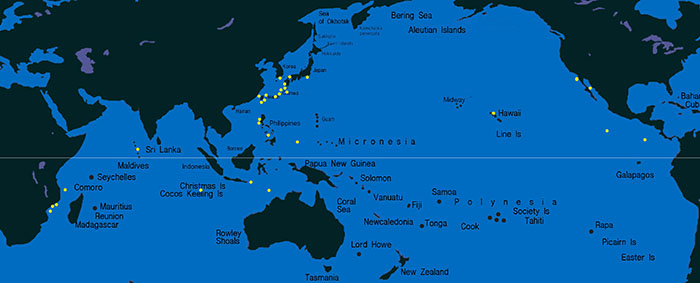 항알치 분포도. Distribution map of Keel-jawed needle fish(Tylosurus melanotus). Data as of May 2023. Author/fishillust.com |
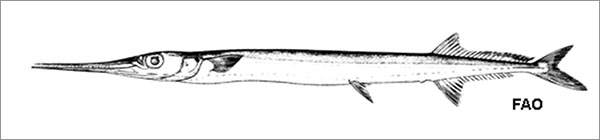 항알치 묘사도. 아래턱 끝에 논쟁거리인 돌기가 없다. 등지느러미의 후단부를 더 높게 표현해야 맞을 것이다. Illustration of Keel-jawed needle fish(Tylosurus melanotus). There is no controversial projection at the tip of the lower jaw. It would be correct if the posterior part of dorsal fin was expressed higher. Author/FAO |
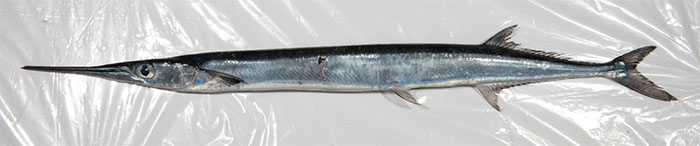 항알치 보존개체. 아래턱 끝에 논쟁거리인 돌기가 없다. Preserved specimen of Keel-jawed needle fish(Tylosurus melanotus). Without controversial projection at the tip of the lower jaw Author/Williams, Jeffrey T. |
 항알치 보존개체. 아래턱 부리 끝에 소위 용골이라고 칭한 돌기가 달려있다. Preserved specimen of Keel-jawed needle fish(Tylosurus melanotus). A protrusion(so-called keel) attached at the tip of the beak on the lower jaw. Author/Williams, Jeffrey T. |


|
| Copyright ⓒ FISHILLUST.COM All rights reserved. All contents can not be used without permission of the copyright holder. |


 검색
