
사이트 로그인
사이트 로그인
|
분류계통/경골상강→조기강→ 달고기목→ 달고기과→민달고기 Copyright by Kim In Young. 김인영 그림
|
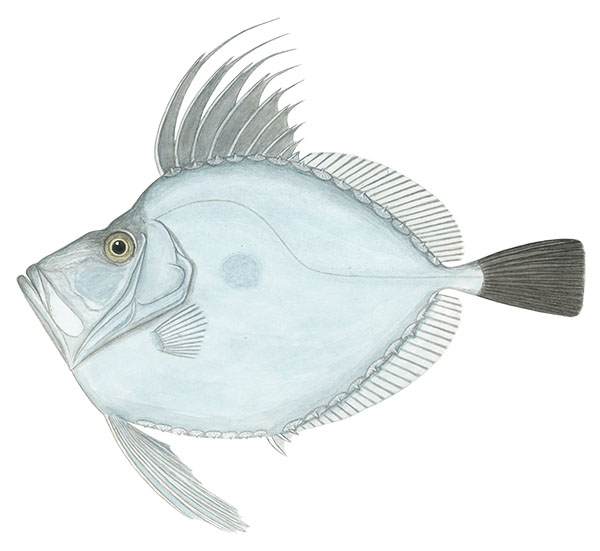 |
| 민달고기 기본 모습. Lateral view of Mirror dory(Zenopsis nebulosa) |
|
Copyright by Kim In Young. 김인영 그림
|
 |
| 민달고기 유어 모습. Lateral view of juvenile Mirror dory(Zenopsis nebulosa) |
달고기목 달고기과 분포; 인도-태평양/한국의 전 연안, 일본 홋카이도 이남, 타이완, 동중국해, 필리핀, 오스트레일리아와 뉴질랜드(인근 섬나라 포함). 북태평양/미국령 샌드 섬(Sand Island), 그린 섬(Green Island)과 미드웨이 환초(Midway Atoll). 동태평양/미국 캘리포니아주 중부와 남부, 페루의 나즈카 해령(Nazca Ridge). 등지느러미는 극조부와 연조부가 연결된 1개로 되어있으며 극조부와 연조부 사이가 낮게 가라앉아 있다. 등지느러미 극조의 막(membrane) 끝은 실 모양으로 길게 연장되어 있다. 배지느러미의 앞쪽 기조들이 매우 길며 뒤는 뒷지느러미 기점을 넘어간다. 뒷지느러미 극조의 막은 실처럼 연장된 부분이 없다. 가슴지느러미는 매우 짧다. 꼬리지느러미 뒤는 절단형이다. 등지느러미 전체 기저부와 배지느러미와 뒷지느러미 사이의 복부 가장자리 및 뒷지느러미 기저부에 가시를 가진 크고 납작한 방패 비늘이 배열되어 있다. 방패 비늘의 수는 등지느러미 기저부에 12-14 개, 뒷지느러미 기저부에 7-9개 복부에 5-7개가 있다. 몸은 비늘이 없이 매끄러우며 매우 작은 비늘이 측선에만 존재한다. 측선은 뚜렷하고 극조부의 중앙에서 급격히 내려와 미병부에서는 직선을 이룬다. 측선은 관(tube) 모양으로 보인다. 몸은 전체가 고르게 은회색을 띠고, 거의 거울처럼 밝다. 꼬리지느러미는 검다. 몸 체측 중앙에 겨우 식별이 될 정도의 희미한 둥근 반점이 1개 있거나 없다. 유어는 은백색 바탕에 크기가 여러 가지인 여러 개의 검은 반점이 몸 측면에 불규칙하게 배열되어 있다. 성장하면서 검은 반점들은 희미해 지면서 수가 줄어들고 마지막에는 몸 중앙에 1개만 희미하게 남거나 거의 안보일 정도로 남는다. 유어기에는 등지느러미 극조부와 꼬리지느러미 및 배지느러미가 검다. 수심 30 - 800m 범위의 해저 바닥 쪽에 서식한다. 어류를 주로 먹는다. 중,대형 생선이며 가끔 저인망 어업에서 잡혀 나온다. 식용 가치가 높은 맛 좋은 생선으로 알려져 있다. 민달고기는 비교적 저렴한 생선이다(일본 기준). 그러나 어획량이 작은 물고기여서 시장에서 잘 발견되지 않는다. 크기가 큰 민달고기는 맛에 있어서 달고기를 앞지른다. 작은 것은 값이 싸고 클수록 비싸다. 몸에 강한 가시가 많고 껍질이 두껍고 질겨서 조리 할 때 조심해야 한다. 뼈는 연하다. 달고기와 매우 유사한 체형이지만 몸 중앙의 검은 점이 달고기는 뚜렷하지만 민달고기는 희미하게 있거나 거의 분별이 안되게 남아 있는 점, 눈 위 머리의 윤곽이 달고기는 직선이지만 민달고기는 약간 오목한 점, 서로 색상이 다른 점 등이 차이점이다. |
Order Zeiformes(dories). Family Zeidae(Dories) Distribution: Indo-Pacific/all around coasts of Korea, south of Hokkaido Japan, Taiwan, East China Sea, Philippines, Australia, New Zealand and elsewhere in the region. North Pacific/Sand Island, Green Island and Midway Atoll of American territory. Eastern Pacific/off central and southern California, USA, the seamounts of the Nazca Ridge in the Peru area Dorsal fin single, and the area between spines and soft rays is sunken low. The tips of the membranes of dorsal fin spines are elongated long as thread-like. The forward set of pelvic fin rays are very elongated, rear end reaching behind the origin of anal fin; Anal fin hard spines not elongated as thread. Pectoral fin extremely short. Caudal fin truncated. Large, flat plates with a spine are arranged along the full base of the dorsal fin, ventral ridge between pelvic and anal fins and the base of anal fin. There are 12-14 bony plates at the base of the dorsal fin; 7-9 at the base of the anal fin; and 5-7 on the abdomen. The body is smooth and lacks scales on the body, but small scales exist only on the lateral line. The lateral line is complete, descends sharply at the center of dorsal fin’s spinous region, and goes straight in the caudal peduncle. Lateral line appears as a tubular line. The body is evenly silvery gray throughout, almost mirror-like brightness. The caudal fin is black. With or without a single, barely discernible, faint round blotch in the center of the body flank. Juveniles have a silvery-white background with several black blotches of varying sizes arranged irregularly on the sides of the body, dorsal fin’s spinous part, tail fin, and pelvic fin are blackish. As they grow, the black blotches fade and decrease in number, eventually leaving only one faint or barely visible blotch in the center of the body. It lives close to the sea bed between 30 and 800 meters deep. It mainly eats fish. Medium and large fish, occasionally caught by bottom trawl nets, have delicious meat and great food value. It is a relatively cheap fish, and it is difficult to find it in retail stores because it is not caught in large quantities. Large-sized Mirror dory have a superior taste to John Dory. Small ones are very cheap. Larger items are a little more expensive. The skin is thick and strong. Bones are soft. Be careful as there are strong spines around the body. The body shape of Mirror dory is very similar to that of John dory(Zeus faber), but the differences include a dark blotch in the center of the body is distinct in John dory but faint or barely discernible in Mirror dory, the outline of head above the eye is straight in John dory but slightly concave in Mirror dory, and the different colors each other. |
 민달고기 분포도. Distribution map of Mirror dory(Zenopsis nebulosa). Edited by fishillust.com/(Kim in young) |
|
|
 일본 해양-지구 과학기술 연구소가 대심도 무인 잠수정으로 촬영한 민달고기. 유어와 성어 사이 중간 크기로 보인다. A Mirror dory(Zenopsis nebulosa) photographed by JAMSTEC(Japan Agency for Marine-Earth Science and Technology) using a deep-dive unmanned submersible. It appears to be intermediate in size between juvenile and adults. Source/Smithsonian. (CC BY NC) |
 민달고기 죽은 개체. Dead specimen of Mirror dory(Zenopsis nebulosa). Place/22 n.miles off Cape Hawke, NSW, Australia. Author/Ken Graham. (CC BY-NC). |
 민달고기 보존 개체. preserved specimen of Mirror dory(Zenopsis nebulosa). Author/Australian National Fish Collection(CSIRO). (CC BY-NC). |
 생선시장의 민달고기. 장소/중국 절강성 타이저우시, Mirror dory(Zenopsis nebulosa) in fish market. Location/中国浙江省台州市(Taizhou City, Zhejiang Province, China). Author/Future. (CC BY-NC). |
 민달고기 묘사도. Illustration of Mirror dory(Zenopsis nebulosa). Creator/Griffin, L. T, artist. Author/Auckland Museum Collections from Auckland, Aotearoa New Zealand.(CC BY-NC). |
 살을 벗겨내고 착색시킨 민달고기 투명 표본. 출처/대만 국립 해양생물 및 해양생물 박물관. Cleared and stained specimen of mirror dory(Zenopsis nebulosa), in the collections of the National Museum of Marine Biology and Aquarium in Pingtung, Taiwan. Author/Tiouraren(Y.-C. Tsai) |


|
| Copyright ⓒ FISHILLUST.COM All rights reserved. All contents can not be used without permission of the copyright holder. |


 검색
 민달고기 성어의 체형도. 왼쪽 그림은 완전한 성어의 체형이며 색상 표현은 생략된 그림이다. 우측 그림은 실처럼 연장된 등지느러미 극조의 막 길이가 긴 것으로 보아 덜 자란 성어로 보인다.
 왼쪽/민달고기의 아주 어린 유어 사진. 아래 쪽에 표시된 1cm 길이 표시를 기준으로 물고기 크기를 추정해 볼 것. 채집 장소/오스트레일리아. 오른쪽/민달고기 유어 체형도. 1903년 오스트레일리아 로드 하우 섬(Lord Howe Island)에서 채집된 개체를 모델로 한 그림.
