
사이트 로그인
사이트 로그인
|
분류계통/경골상강→조기강→쏨뱅이목→양태과(良太科)→오치아이양태 Copyright by Kim In Young. 김인영 그림
|
| image on preparing |
| 오치아이양태 기본 모습. Lateral view of Ochiai flathead(Inegocia ochiaii) |
쏨뱅이목 양태과(良太科) 분포; 서북태평양/동아시아에서만 발견되다. 한국의 제주도, 일본 카나가와 현의 사가미 만 이남(일본 중부 서해안의 와카사 만과 일본 중부의 남쪽 태평양 외해의 하치죠지마 섬 포함), 타이완, 중국의 하이난 섬에 분포. [Note2] 2023년 6월 현재, 인터넷 망에서 아직 Inegocia ochiaii의 한국명은 찾아지지 않는다. 영어 일반명은 없으며 일본 이름은 ワニゴチ(와니고치)인데 한국식으로 말하면 “악어양태”라는 뜻이다. 만약 이 종을 한국명으로 “악어양태”라고 부른다면 이미 있었던, 그러나 최근 재분류 과정에서 삭제된 종인 Inegocia guttata의 한국명인 악어양태와 혼선이 일어난다. 따라서 필자는 혼선을 피하기 위해 Inegocia ochiaii의 한국명을 종소명(ochiaii)을 차용하여 “오치아이 양태(Ochiai flathead)”로 부르기로 하였다. 이는 학술계가 정하지 않은 임시 한국명이다. 일본에서는 이 종을 영명으로는 “Bartail flathead”라고 한 자료가 있으나 글로벌 데이터에서는 Bartail flathead는 종이 다른 Platycephalus indicus의 영명으로 나타남으로 이 또한 한국명으로 사용하기가 적절하지 않은 이름이다. ※ 학명 Inegocia ochiaii는 양태과를 포함해 어류 분류학에 많은 공헌을 한 오치아이 아키라 박사를 기리기 위해 명명되었다. 몸은 위아래로 납작하고 빗비늘로 덮여있으며 몸 하부 면에는 원형비늘이 일부 있다. 머리는 위아래로 납작하고 길이는 체장의 1/2.8 이다. 눈 뒤, 아가미뚜껑, 목의 뒤쪽에 비늘이 있다. 주둥이는 가늘고 눈 지름보다 훨씬 길다. 눈 위쪽 피부에 돌기가 없다. 눈 위쪽 가장자리에 눈(홍채)을 가리는 술 장식(lappet;래핏)이 있다. 이 래핏은 눈을 가리는 위장술로 사용되며 확대 또는 축소된다. 두 눈 사이 간격은 큰 편이며 밑으로 약간 패였다. 안구의 뒤 가장자리에 있는 함몰 부분은 분명하지 않다. 머리 위와 측면에 가시들이 있다. 코에 작은 가시 1개가 있다. 눈 아래 융기부에 2개의 가시가 있다. 눈 위 융기부의 뒤쪽은 거칠게 톱니형이다. 눈 뒷부분, 익이골(翼耳骨), 정수리. 측두(側頭) 상부, 의쇄골(擬鎖骨) 상부, 후측두골 좌측에 각각 1개의 가시가 있고 후측두골 우측에는 2개의 가시가 있다. 전새개골에 2개의 가시가 있으며 위쪽 가시가 더 길고 아가미뚜껑의 뒤 가장자리에 이르지는 않는다. 주새개골의 위와 아래 가시는 톱니 구조가 없다. 두 눈 사이에 1개의 큰 피편돌기(flap; 皮片突起)가 있다. 위턱 뒤는 눈의 앞 가장자리에 이른다. 양턱과 구개골에는 융털 모양의 이빨 띠가 있고 서골에는 작은 송곳니들이 2개의 그룹(패치)으로 모여있다. 위턱의 맨 앞 가운데 부분에는 작고 가는 송곳니가 있다. 입술 가장자리에 돌기 같은 것들은 없다. 눈 아래와 전새개골의 감각 튜브는 발달하지 않았으며 뺨 부분으로 확대되지 못했다. 측선의 앞 부분 비늘들은 감각 구멍이 비늘 뒤 쪽에만 있거나 또는 앞 뒤 양쪽에 있으며 측선의 뒤쪽 비늘들은 비늘 양쪽에 감각 구멍을 가지고 있다. 제1등지느러미는 아가미뚜껑 가장자리보다 약간 뒤에서 시작된다. 제1, 제2등지느러미 사이는 좁게 떨어져있다. 가슴지느러미 뒤는 둥글며 길이는 머리 길이의 약 1/2.5 이다. 꼬리지느러미는 뒤가 둥글며 길이는 머리 길이의 약 1/1.9 이다. 몸색과 무늬 모양은 환경에 따라 심하게 변한다. 기본적인 색상은 이렇다. 머리와 몸의 바탕색은 황갈색이며 등에서 측면으로 연속된 약 8개의 검은 암갈색 수직 방향 띠가 있는데 머리에 2개 몸에는 6개가 있다. 머리에 있는 2개 중 한 개는 눈을 관통해서 내려가며 다를 한 개는 아가미뚜껑 후단으로 내려가 있다. 띠 무늬는 검은 색이 누덕누덕 칠해진 모양이다. 꼬리지느러미에도 같은 패턴의 검은 수직 띠 2개가 있다. 나머지 부분에는 무수한 작은 갈색 점들이 조밀하게 산재되어 있다. 모든 지느러미들은 크고 작은 암갈색 점들을 가지고 있으며 이 점들이 이어진 줄 모양을 형성하기도 한다. 꼬리지느러미의 뒤 가장자리는 좁게 흰색이다. |
Oder Scorpaeniformes Family Platycephalidae(Flatheads). Distribution; North western Pacific/Known only from East Asia. Jeju Island of Korea, south of Sagami Bay in Kanagawa Prefecture of Japan(including Wakasa Bay off the west coast of central Japan and Hachijojima island in Pacific Ocean off central Japan, Taiwan, Hainan Island of China. [Note2] As of June 2023, Korean name for Inegocia ochiaii is not found on the Internet. It has no English common name, and its Japanese name is ワニゴチ(wanigochi), which translates to "crocodile flathead" in Korean. If this species is to be called "crocodile flathead," it would be confused with the “crocodile flathead” which is the former Korean name of Inegocia guttata, a species that recently deleted during the reclassification process. To avoid confusion, I have decided to call Inegocia ochiaii "Ochiai flathead" by borrowing the epithet(ochiaii). This is a temporary Korean name that has not been settled by the scientific community. In Japan, there is data that this species is called "Bartail flathead" as English common name, but global data shows that Bartail flathead is the common name of a different species, Platycephalus indicus, so this is also not appropriate to use as a Korean name. ※The scientific name Inegocia ochiaii is named in honor of Dr. Akira Ochiai, who made many contributions to fish taxonomy, including those for the Platycephalidae. Body depressed, mostly covered with ctenoid scales, some cycloid scales on undersurface. Head flattened, length 2.8 (2.6–2.8) in SL; postorbital region, opercle and nape scaled. Snout slender, much longer than orbital diameter. Upper surface of eye without papillae. The upper edge of the eye has a tasseled lappet that covers the eye(iris). This lappet is used for camouflage the eye and can be enlarged or reduced. Interorbit moderately broad and shallowly concave. Posterior margin of orbit lacking distinct pit. Top and side of head possessing spines. Nasal with single small spine. Suborbital ridge with 2 spines below eye. Supraorbital ridge roughly serrated posteriorly. Postorbital region, pterotic, parietal, supratemporal, supracleithrum and left side of posttemporal with single spine, respectively; right side of posttemporal with 2 spines. Preopercle with 2 spines, upper longest, not reaching posterior margin of opercle. Ridge of upper and lower opercular spines without serrations. Single large interopercular flap present. Maxilla reaching anterior margin of eye. Villiform teeth in bands on palatine and jaws, small conical teeth in 2 separate patches on vomer, anteromedial portion of upper jaw with small and slender conical teeth. Lip margins without papillae. Sensory tubes from suborbitals and preopercle undeveloped, not covering cheek region. Scales anteriorly on lateral line with either single posterior opening or with 2 openings, scales posteriorly on lateral line with 2 openings. First dorsal fin originating slightly posterior to opercular margin. First and second dorsal fin narrowly separated. Pectoral fin rounded posteriorly, length 2.5 (2.3–2.8) in HL. Posterior tip of pelvic fin attaining anal-fin origin (position of posterior tip of pelvic fin ranging from anterior to anal fin to base of third ray), pelvic-fin length 1.4 (1.3–1.6) in HL(head length). Caudal fin slightly rounded posteriorly, length 1.9 (1.7–2.2) in HL. The body color and patterning changes dramatically depending on the environment. The basic colors are; The ground color of the head and body is yellowish brown and lower side pale brown. With about 8 black and dark brown vertical bands running from the back to the side, 2 on the head and 6 on the body. Of the two on the head, one runs down through the eye and the other runs down the back of the opercula. The bands look like they've been smudged with black. The caudal fin also has two black vertical bands in the same pattern. The rest is densely interspersed with countless small dark brown dots. All fins have large and small dark brown dots, sometimes forming a continuous line. The trailing edge of the tail fin is narrowly white. |
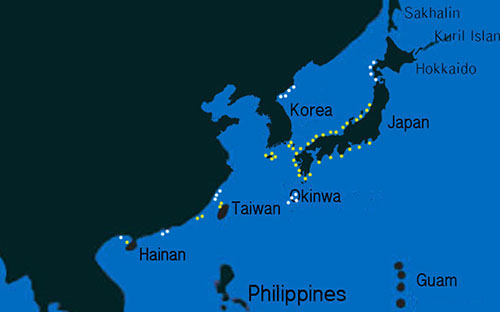 오치아이양태 분포도. 백색점은 분포 가능성 있는 해역. Distribution map of Ochiai flathead(Inegocia ochiaii). White dots indicate areas of likely distribution. Main reference/AquaMaps(2019, October). Author/fishillust.com 오치아이양태 분포도. 백색점은 분포 가능성 있는 해역. Distribution map of Ochiai flathead(Inegocia ochiaii). White dots indicate areas of likely distribution. Main reference/AquaMaps(2019, October). Author/fishillust.com
|
 오치아이양태. 수중사진. 색상이 어두운 모래밭에 위장하고 있음. Ochiai flathead(Inegocia ochiaii). Underwater photo. Camouflage on a dark sandy bed. location/probably Japan. Wikimedia photo. Author/Izuzuki(CC BY-NC).
|

| 오치아이양태의 유어. Juvenile of Ochiai flathead(Inegocia ochiaii). location/Kantō region, Kanagawa Prefecture, Japan. publisher/inaturalist. Author/shunhirota. (CC BY-NC) |


|
| Copyright ⓒ FISHILLUST.COM All rights reserved. All contents can not be used without permission of the copyright holder. |


 검색
검색 