close_btn

물개복치(Sharptail sunfish). Masturus lanceolatus(Lienard, 1840).. Family 511. .


분류계통/경골상강→조기강→복어목→물개복치 Sharptail sunfish; Masturus lanceolatus
Superclass Osteichthyes→Class Actinopterygii→Order Tetraodontiformes→Family Molidae→ Sharptail sunfish; Masturus lanceolatus

Copyright by Kim In Young. 김인영 그림
Masturus_lanceolatus1_mypainting_700.jpg
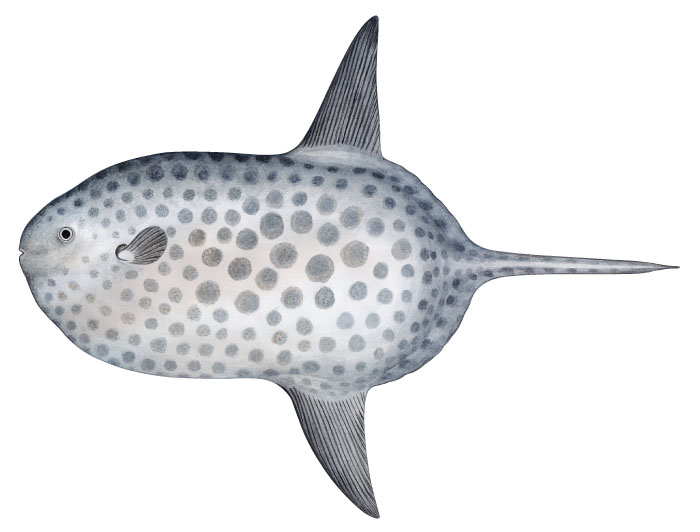
[painting 1]. 물개복치의 기본 모습. Lateral view of Sharptail sunfish(Masturus lanceolatus).

Copyright by Kim In Young. 김인영 그림
Masturus_lanceolatus2_mypainting_700.jpg
[painting 1]. 물개복치의 유어 모습(13cm경). Juvenile Sharptail sunfish(Masturus lanceolatus). At about 13cm.

복어목 개복치과 Order Tetraodontiformes Family Molidae(molas, ocean sunfishes)
물개복치 Sharptail sunfish
Masturus lanceolatus (Lienard, 1840). 337cm(TL) 2,000kg.
D/soft ray15~19. A/soft ray15~19. C/7~9(Clavus)

분포; 세계의 열대와 온대 해역에 분포한다.
일반개요; 외관이 개복치(Ocean sunfish; Mola mola)와 유사하지만 클라부스(clavus; 가짜꼬리지느러미 또는 키지느러미)가 뒤로 튀어나온 것으로 우선 구별할 수 있다. 계란형 몸체이며 머리 앞 부분의 볼록 포물선이 굴곡 없이 고르다. 눈은 개복치 눈보다 더 머리의 앞쪽에 위치한다. 양 턱의 이빨은 앵무 부리 형으로 융합되었다. 등지느러미와 뒷지느러미는 몸의 뒤쪽에 있고 등지느러미의 기부는 뒷지느러미의 기부보다 길다. 꼬리지느러미 자리에는 등지느러미와 뒷지느러미의 일부가 합쳐져서 생긴 클라부스(clavus; 키지느러미)가 있다. 일부 학자들은 이 클라부스가 유생 시에 있었던 꼬리지느러미가 없어지고 남은 흔적이라고 말한다. 이 이론들은 아직 논쟁 중에 있다. 클라부스의 기조 수는 18~ 20개이다. 클라부스의 중앙 줄기는 마지막 척추 뼈가 지주해주고 있으며 길게 연장된 삼각형 엽(lobe; 葉) 모양을 가진다.

물개복치의 피부는 피부치(dermal denticles)로 덮여있으며 개복치의 피부치보다 크기가 작다. 체색은 기본적으로 은백색이며 위쪽 측면이 회갈색 내지 검은 색이다. 측면에 뚜렷하지 않은 검은 점들이 있을 수 있다. 등지느러미와 뒷지느러미는 슬레이트 회색이며 클라부스에 희미한 반점들이 있을 수 있다. 기본적으로 수심 100m 이내에 사는 표해수층(表海水層) 어류이지만 얕은 수면 층에서는 잘 발견되지 않으며 발견되는 것들은 병든 것이나 기생충에 감염된 것들이 많다. 낮에는 5–200m 수심 사이에서 섭씨 20도의 수온 대에 머물면서 수시로 깊은 수심으로 내려갔다 올라오는데 먹이를 찾는 것 같기도 하고 포식자를 피하기 위한 것 같기도 하다. 야간에는 100m와 250m 사이에 내려가 있다. 1,000m 이상으로 내려가기도 한다. 멕시코 만에서 실시된 한 인식표 부착 관찰 실험에서 물개복치는 하루 평균 10 km를 이동했다.

물개복치는 개복치와 마찬가지로 긴 등지느러미와 뒷지느러미로 노를 저어 전진한다. 등지느러미보다 뒷지느러미를 더 크게 젓는다. 작은 가슴지느러미를 계속 움직여 몸의 균형을 잡고 클라부스(Clavus; 키지느러미)로는 방향타처럼 방향을 조정한다. 해파리, 살파를 주식하며 물고기와 갑각류 연체동물도 먹는다. 어린 새끼들은 바닥에 사는 갯지렁이류와 해면을 먹는 것으로 알려져 있다.

타이완의 개복치 축제
타이완의 후아리엔(Hualien) 카운티에서 2002년 개복치 축제(ocean sunfish festival)를 시작한 이후 개복치 고기의 수요가 크게 증가하였다. 이 지방에서는 그 전에는 개복치의 내장과 정소만 사용되고 나머지는 다 버렸었다. 4월 한달 간 열리는 축제에서 “개복치 먹는 법 101가지” 행사가 진행되며 12만명의 방문객들이 온다. 이로 인해 타이완 동부 해역에서 개복치류 어획랑이 대폭 증가하였는데 어획의 90%가 물개복치이다. 2005년에 208톤이 잡혔고 년간 100만 달러 가치의 어획고을 올리고 있다. 청치망, 유자망, 주낙으로 잡는다. 타이완의 개복치 남획이 어떤 결과를 가져올지에 대해 연구가 진행되고 있다. (기사 출처/ wikipedia.org/wiki/Sharptail_mola)

Masturus_lanceolatus_NOAA_500.jpg
수면 가까이에서 옆으로 누워있는 물개복치. Sharptail mola near the surface. Author; NOAA/PIRO Observer Program


Order Tetraodontiformes Family Molidae
Sharptail sunfish
Korean. n. Mul-gae-bok-chi (물개복치)
Masturus lanceolatus (Lienard, 1840). 337cm(TL) 2,000kg

Distribution: All tropical and warm temperate waters including East Sea of Korea.
General: It is similar in appearance to the ocean sunfish(Mola mola), but can be distinguished by the projection on its clavus(pseudo-tail). It has an oval body with an evenly convex forehead profile. The eyes are placed more forward on the head than in the genus Mola. The teeth in both jaws are fused into beak-like plates. The dorsal and anal fins are placed posteriorly, and the base of the dorsal fin is longer than that of the anal fin. In place of a caudal fin, the dorsal and anal fins merge into a clavus, some authors believe these rays to be remnants of the larval caudal fin, though this is disputed. The clavus formed by 18-20 fin rays. The central rays in the clavus are supported by the last vertebra and form an elongated triangular lobe. Their skin is covered with small dermal denticles that are finer than those of the ocean sunfish. Their coloration is silvery with the upper parts of the sides grayish brown to blackish. The sides may bear ill-defined dark spots. The dorsal and anal fins are slate gray, while the clavus may have pale blotches.

They are primarily inhabitants of the epipelagic zone, but are rarely sighted at the surface, with many of those appearing to be ill and parasite-ridden. During the day, they spend most of their time at depths of 5–200 m, preferring water temperatures above 20 °C, but making repeated dives into cooler, deeper water, possibly to feed or to avoid predators. At night, they spend most of their time between 100 and 250 m. They have been sighted in the mesopelagic zone to a depth of 670 m, but may descend to over 1,000 m. One tagged individual in the Gulf of Mexico moved an average of 10 km a day. The swimming mode of the sharptail is similar to that of other ocean sunfishes, using sculling motions of its long dorsal and anal fins to propel itself through the water. The anal fin moves more extensively than the dorsal fin. The small pectoral fins move constantly to control pitch, while the clavus is employed as a rudder. Juvenile sharptail molas are known to feed on benthic annelids and sponges. Adults likely feed on medusae, siphonophores, ctenophores, and salps, as well as some fishes, crustaceans, and molluscs.

Sunfish festival in Taiwan
Since 2002, promotion of an ocean sunfish festival in Hualien County, Taiwan, has increased demand for the meat of the sunfish (called "mambo fish" after a public vote), whereas before only the intestines and reproductive organs were sold while the rest of the fish was discarded. The month-long April festival draws some 120,000 visitors, and features "101 ways to eat" sunfish. Consequently, catches of sunfishes off eastern Taiwan have risen sharply, with the sharptail mola comprising 90% of the catch. In 2005, 208 tonnes were landed and the annual sunfish catch was valued at US$ one million. The species is caught by set net, drift net, and longline fisheries. The impact of this increased exploitation on sunfish stocks is under investigation. (Subtracted from wikipedia.org/wiki/Sharptail_mola)


Copyright ⓒ FISHILLUST.COM  All rights reserved. All contents can not be used without permission of the copyright holder.